Why “Affordability” Is the Wrong Word for This Crisis
How the affordability crisis turned democratic failure into a technical problem.
What is the affordability crisis? The language alone — “affordability” — implies that we are all consumers looking to buy basic goods like food, housing, and health care. This is obviously true, but the framing the liberal class uses on this issue is conveniently narrow. Focusing on affordability implies that this is simply a prices problem. It allows technocrats to propose solutions aimed at “getting costs under control.” What’s really at stake is a crisis of political economy — how economic life is structured by power — which technocracy exists to obscure.
This is how we end up with proposals like California Senator Adam Schiff’s Housing BOOM Act. Schiff’s proposal is the ultimate technocratic solution. Here is how the Los Angeles Times describes the bill:
It would create a $10-billion annual loan fund and a $5-million annual grant program to expand affordable housing for middle-income families, as well as a federal grant program to convert hotels and unused residential properties into transitional housing or emergency homeless shelters. The proposal also calls for establishing a new office within the Department of Housing and Urban Development to protect people from eviction.
When I worked on Capitol Hill, I saw hundreds of bills like this. It is the governing logic of a political class that treats politics as a financing and management problem rather than a question of democratic control, the sad ceiling of the political imagination of the liberal class. On housing (as with nearly everything else), as I’ve recently written in The Lever, neoliberal economics still dominates the political consensus, with government existing primarily to subsidize private developers, landlords, and markets. Consider the language Schiff uses to describe the bill: a “landmark expansion of the Low-Income Housing Tax Credit (LIHTC), a stackable tax credit that would inject the financial capital needed to spur the development of more affordable housing projects.”
This is the same logic that brought us the Affordable Care Act — government exists to work harmoniously alongside private financial actors. At the time, the ACA promised stability and a long-term solution, while it was hailed by its liberal supporters as the greatest possible achievement of the decade. But look where we are now. The American health care system, like the housing market, is on the verge of collapse.
Technocratic solutions — by which I mean policies that treat economic crises as technical problems to be optimized by experts, rather than political questions to be decided democratically — have lost legitimacy with the public. This is not because technocracy is inherently bad, but because the version we have has been captured by corporate power. Technocrats now exist to administer the policies of a bipartisan political class that has resigned itself to the dismal logic of our time: government is not the solution; the market is. Meanwhile, over half of the population lives paycheck to paycheck.
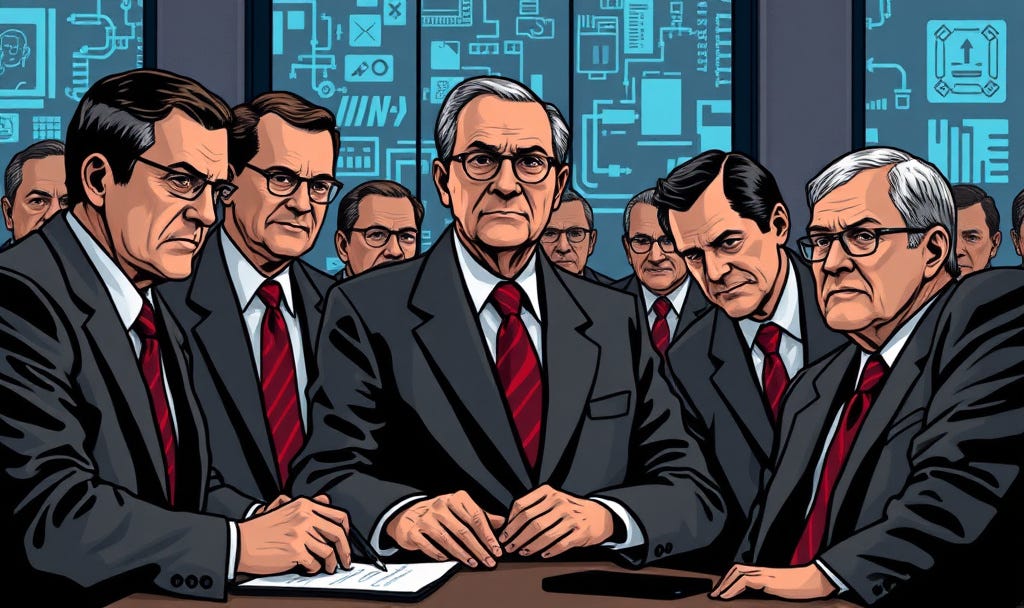
The whole framing of “affordability” isn’t an attempt to rethink the system but to manage perceptions of it. This is how we end up with pollster Frank Luntz declaring on CNBC that people don’t trust the government and don’t want government to fix their problems — though he never makes the connection as to why. Luntz, much like Sarah Longwell, exists to manage focus groups in which citizens are reduced to consumers of political messaging. The CNBC host predictably pressed Luntz around “the gap in the messaging,” while Luntz scolded voters over inflation, insisting that what matters is “not reality but perception” — that if you perceive something is happening, you’ll believe it to be true.
Corporations convince politicians, through generous donations, that government’s role is not to directly serve the public but to funnel money through private actors. A technocratic apparatus — government bureaucrats at agencies like HUD — administers these policies. And pollsters and consultants, working alongside the media, help uphold the narrative that keeps the system intact.
Rejecting the Frame
It’s not conceding anything to admit that people want to be able to afford the basics of life. But what if we rejected the terms of debate set by the liberal class? Instead of focusing on prices and costs, we could talk about workers — the people administering this crisis on the frontlines. Grocery workers who watch customers remove items from their carts once they see the total. Health care workers who spend hours on the phone with insurance companies just to get authorization to care for a patient. Landlords (not all of them bad) who try to avoid evicting tenants but cannot absorb the costs without risking their own homes.
These situations are not simply about “affordability,” but about power. They contest the liberal class on terrain it would rather avoid. CNBC doesn’t want to talk about the power of organized labor. Adam Schiff doesn’t want to tell his developer donors they can’t receive government subsidies.
What’s at stake for the liberal class is not just policy preference, but the ability to control the levers of government on their terms. But their terms have lost legitimacy with the public. This is why they are so focused on dominating and managing the debate around affordability. As long as the crisis is discussed in their language of prices, costs, incentives, and messaging, they remain necessary. Neoliberal technocratic governance — the only model they know — depends on being the indispensable intermediary between economic pain and political response.
The challenge for the left is to build a movement big enough and that focuses on power directly. Because when workers become the focus point, when they start to ask who owns and who decides, when they describe how they are the ones forced to administer scarcity, the liberal class loses its role as translator and manager.
The biggest fear of the liberal class is that they will no longer be needed. Technocracy is designed to mask their failures and rests on the assumption that authority flows from expertise and top-down management. As long as economic pain is filtered through their frameworks, their role remains secure.
The public has already begun withdrawing its consent from this system — which is why figures as different as Donald Trump and Zohran Mamdani can emerge from the same moment of breakdown. But the liberal class has not been defeated, it retains control over institutions, media, capital, and the terms of debate itself. What we are witnessing is not the end of technocratic governance, but its increasingly desperate attempt to reassert authority in a post-legitimacy moment. Affordability is the language it has chosen to manage discontent.
Rejecting that language does not mean denying the very real struggle to afford food, housing, or health care. It means refusing a frame that treats those struggles as pricing issues rather than a crisis of political economy. As long as the crisis is described as one of affordability, it can be endlessly managed by experts. Once it is understood as a crisis of power — of who owns, who decides, and who bears the costs — it becomes a democratic question. That is the conversation the liberal class is trying to avoid.
If you like this work, please consider becoming a paid subscriber to help me do this full time and fund more reported pieces. Thanks so much for reading!
Excellent framing of how technocracy masks power dynamics. The point about workers administering scarcity on the frontlines is something that doesn't get nearly enough attention in these debates. I worked retail for a few years and seeing customers put items back at checkout was def one of those moments that made me realize the system was way deeper than just "prices going up." When the crsis gets reframed as one of control rather than costs, it opens up totally different solutions that challenge existing power structures instead of just managing them better.
Thanks for another superb post. This may be your best yet. Adam Schiff is precisely the sort of technocrat who paved the way for Donald Trump. Sadly, the so-called liberals believe their own b.s. It has been very very good to them.