Political Theater
And dystopian novels.
A year before the Brett Kavanaugh-Christine Blasey Ford hearings, Hulu released the first season of The Handmaid’s Tale, based on Margaret Atwood’s famous novel. A few years earlier, I had read the book for the first time in a book club with my high school friends. Many of us were homesick for a routine we’d aged out of. A book club also seemed like something real adults do.
The novel is a disturbing portrayal of a society in which women are forced into sexual servitude to replenish falling birth rates. The villains are clear. The Commanders, the all-male leaders of Gilead, a totalitarian theocratic state. The Handmaids, enslaved women forced to have sex with powerful men while their wives look on, are the protagonists. The reader is left holding onto the hope that there might be a way out, an escape from their suffocating circumstances.
Atwood famously described the book as speculative fiction, something more realistic than science fiction. The idea was that Atwood’s fictional world may be closer to reality than we would like to think.
That year, I went down a rabbit hole of dystopian novels. I read Yevgeny Zamyatin’s We and Emily St. John Mandel’s Station Eleven.
While they each left a lasting impression, I never experienced such visceral sadness as I did reading Kazuo Ishiguro’s Never Let Me Go. The protagonists are three young people who are not enslaved through force. They go to school, make art, develop relationships, and are made to feel chosen and special. They internalize their fate so deeply that they come to accept their roles in society.
In Ishiguro’s world, set in an English boarding school in the 1990s, students are raised to fulfill society’s need for organ donors. Their fate is inevitable, yet the illusion of another path is carefully maintained by society. The students are told that if they can make great art and prove they are genuinely in love, they can earn deferrals, a bit more time.
The Hart Senate Office Building sits out of place, its harsh 1970s modern aesthetic a sharp contrast to its fireplace-laden neoclassical counterparts. It has been described as having been built for the computer era.
To get there from my desk in the Rayburn House Office Building took an elevator to the sub-basement, a tram to the Capitol, and another tram to the Senate buildings. Or you could go outside and walk. Passing the glow of the dome, there would likely be a press conference, with members of Congress gathering in front of cameras to garner publicity for their latest bill introduction.
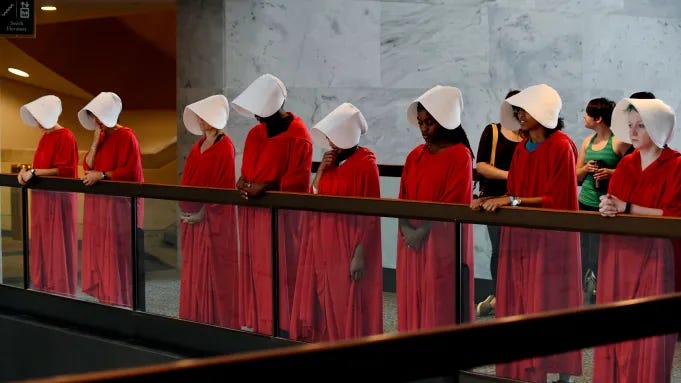
More often than not, like most Americans, I experienced the Hart Office Building through social media clips and cable news segments. I was at my desk when a viral clip circulated of several women dressed as Atwood’s Handmaids in their distinctive dark red robes and white wide-brimmed bonnets. They stood silently on a balcony, peering into the building’s grandiose, sterile atrium of white marble and stone. Whether intentional or not, the symbolism of that image replicated Atwood’s most chilling insight. The Handmaids stood in watchful silence under the eye of an institution. Tourists took pictures. Vanity Fair ran a profile. Activists reposted the image on social media.
CNN uploaded a clip to YouTube titled “Fireworks erupt at beginning of Brett Kavanaugh hearing.” It has over five million views. In it, Democratic senators pull out procedural tricks to interrupt the process. I understood at that point that it had been rehearsed. That was how the committees functioned. Each had its own staff. Sample questions were circulated, increasingly written in hopes of striking it big with the next viral moment. In the clip, at first, the “rising star,” the recently elected Democratic senator from California, Kamala Harris, interrupts the Republican chairman. Not enough time to review the documents, she claims. “Why are we rushing this?” chimes in New Jersey Democratic Senator Cory Booker.
The balance of the Senate was fifty-three Republican votes to forty-seven Democratic ones. Confirming a Supreme Court nominee required a simple majority.
The movement that had brought on the Women’s March, the pussy hats, and the visceral anger at men like Donald Trump showed up to the Kavanaugh hearings in a state of permanent emergency. The hearings rolled on only to be routinely interrupted by activists who rose from their seats in the committee audience. “This is a travesty of justice,” they shouted, along with “cancel Brett Kavanaugh.”
Planned Parenthood fact-checked the judge’s record. Their verdict was that his confirmation would be dangerous to women. “None of this is business as usual,” their website declared, citing 1.5 million people who had signed petitions calling on senators to reject Kavanaugh.
Days after Kavanaugh was announced as Trump’s nominee, three months before the hearings, Ilyse Hogue, the president of NARAL, another powerful pro-choice lobbying organization, said it was absolutely necessary to block the nominee to protect abortion access.
The handmaids, the activists, the petitions all existed before the world had heard the allegations against Kavanaugh by Christine Blasey Ford, a psychology professor in California.
Ford had written to her senator, Democrat Dianne Feinstein, warning her of something she ought to know. As teenagers, Ford alleged, Kavanaugh had tried to rape her.
The letter leaked. Ford pledged to testify publicly. Millions of Americans tuned in.
Ford was composed, careful with her words, generous in responding to the committee’s questions. Kavanaugh was brash, rude, and hysterical. I watched alongside my colleagues in disgust. How brutally unfair, we thought.
For a few days, it seemed as if Ford’s allegations might make a difference after all. The New Yorker reported that a second woman had come forward with claims against Kavanaugh. When Senator Jeff Flake announced his intention to vote to confirm him, activists Ana Maria Archila and Maria Gallagher blocked his elevator, putting their bodies between him and the doors. A tearful Gallagher told Flake he was sending a message to women everywhere, that telling the truth would only help powerful men rise anyway.
Flake agreed to delay the vote, making it contingent on a one-week FBI investigation. The confirmation was deferred. Six years later, Democratic Senator Sheldon Whitehouse of Rhode Island released a report calling the investigation a “sham” and implying that the White House had obstructed the process to “put Justice Kavanaugh back on the political track to confirmation.”
The other Republican senator activists hoped to persuade was Maine’s Susan Collins. She was a pro-choice Republican woman whom they believed ought to believe other women.
When Ishiguro’s students, destined to be harvested for their organs, go to visit Madame to prove they are in love and request their deferrals, they are told the deferrals never existed. Their artwork, which Madame collected, was never meant to save them. It was meant only to prove to the outside world that they had souls, so the “normals” could feel better about the harvest. The promise functioned only to make the system appear humane without ever altering its outcome. Madame is genuinely upset by the children’s fate, but it does not stop her participation in the system.
Collins went to the Senate floor. Her two female colleagues sat behind her, framed into the camera shot. She announced her decision to vote to confirm Kavanaugh after all. She told CNN she believed Ford believed Kavanaugh had attacked her, but Kavanaugh denied the allegations. Both were under oath. There simply was not enough evidence.
He had the votes, and the confirmation proceeded.
The Handmaid’s Tale is most known for its portrayal of the enslavement of women and for invoking a sense of rebellion against injustice. But like Ishiguro, Atwood ends the book with a much more haunting proclamation. It is the year 2195. Gilead has fallen and professors are studying transcripts from the period at a historical symposium. The protagonist Offred’s recorded tapes are being analyzed. The professors warn against moral judgment, preferring bureaucratic neutrality. Her pain, and that of so many others, is absorbed.
The system hums on.
I’ve spent 35+ years as an activist and advocate for women’s health, focusing on childbirth and bodily autonomy. I'm working on a book, and I could have written something similar to your essay.
It is scarier now—today’s women are distant from the idea of autonomy unless it’s framed within medical choices, and they are thus more afraid of their own bodies than when I began.
The idea of choices is so much playing out as theater.
The return of homebirth midwifery once felt like real hope for bodily autonomy, giving birth outside of the system, and the avoidance of unnecessary routine procedures for the convenience of the industry.
Still, as it has become embedded in the medical field, that hope has slipped away.
Your essay nails that tension between ritual, spectacle, and the reality women actually live.
what a great essay, Evelyn!