“I’ve got one of those,” I said to Paul, my octogenarian canvassing partner for the 2024 election, in which our House seat in Oregon had been deemed “highly flippable” and “one to watch” by national political consultants.
“State car!” he joked as I took the passenger seat in his early-2000s Subaru Outback.
Paul and I had both come to Oregon from the East Coast professional milieu. He had spent decades working for the State Department before retiring to the mountains of Central Oregon to pursue his love of outdoor recreation. His wife, well into her seventies, still taught newbies how to downhill ski.
I told him I’d handle the directions and log the data in the “Get Out the Vote” app I’d hastily downloaded while I scoured Google Maps for our assignment.
“Great. I’ll help with the speech at the door,” he assured me warmly.
I was very happy with this arrangement.
We arrived in a neighborhood on the far east side of town I’d never been to. It had lots of duplexes.
I slowed my gait to match Paul, who had dressed as if we were going on a hike, in battered REI cargo pants and a long-sleeved technical shirt. I pointed to our first assignment, a house on the corner, and suggested for the sake of our digital tracking, we start there and make a loop counterclockwise.
Paul and I stumbled through the script that came preloaded on the app. It wanted us to gauge and log all sorts of valuable data for the campaign: Had this person heard of the candidate? Were they planning to vote? Did they need a ride to the polls? If they said their main concern was health care, we offered a vetted talking point: the candidate had pledged to lower the cost of prescription drugs.
An older woman opened the door, several small, yappy dogs at her feet. Her friend, who happened to live in one of the homes on our list, was there too. They liked to watch television together.
“Tell them I’ll be voting Democrat too!” the friend shouted over the noise.
Paul and I rounded the manicured sidewalk, practicing our script, as half a dozen deer, no more than fifteen feet away, stared back at us.
“It’s rare to see them so unfazed,” he told me with a gentle smile, pulling out his iPhone to capture the moment.
A mother half-opened her door to see what it was we wanted. Paul started talking until she interrupted.
“I’ve been telling my girls, I feel it’s really irresponsible to vote because we don’t have the time to educate ourselves on the candidates.”
I was too stunned to respond. Paul muttered something about our local race being one of the most important in determining the balance of power in the whole country! Neither of us pushed it, though. We walked away without needing to discuss it.
We both understood what had baffled us.
Recently, Jay Caspian Kang published an essay, “How I Became a Subaru Socialist,” in The New Yorker. In it, he argues that a certain kind of millennial—college-educated, professionally successful, even financially comfortable—remains politically shaped by the debt-ridden, underemployed, precarious path that brought us here, leaving many sympathetic to socialism.
Like him, I grew up in the glow of the Obama era hope and optimism for, “multiethnic progress” and believed “that we would all just float up to an era of prosperity and racial harmony.” And like him, I find it painfully hard to summon any more belief in this story.
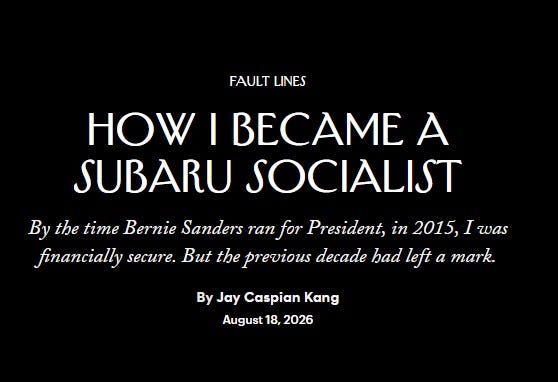
Kang rightly points out that many of the fields that attract college-educated millennials—“academia, the arts, the entertainment industry, even advertising…have far less stability than they once did.” For many of us, and I’ve experienced this firsthand, it feels like a broken social contract. I’ve been embedded in social circles where everyone has fancy degrees and professional credentials from the highest levels of our institutions, but experience regular periods of layoffs, poor pay, and unemployment. And yet, for some, as Kang admits happened to him, the bargain eventually does deliver some version of an upper-middle-class life. Which keeps the rest of us hanging on.
This often forces a noble, genuine—if occasionally cringey—empathy between the Subaru Socialists and the working class. As Kang puts it, “If it sucks for us, how bad must it be for everyone else?”
The privilege of being Subaru Socialists is that we often view our access to the institutions that set the agenda—despite our frustration with and sense of betrayal by them—as evidence of our authority to decide what the problems are. This isn’t inherently bad, but it contains an embedded hierarchy of knowledge. We listen to people after we’ve decided which questions are worth asking. We share a language with one another, absorbed through years spent inside these institutions. We speak on websites like this one of “neoliberalism,” the “working class,” and “disinformation,” but we have fewer answers for the woman at the door who challenges our frame entirely.
Was Paul right to push her to vote for our candidate anyways? Maybe. My education could tell me to lend empathy to the woman, she’s busy, maybe overworked, maybe one of her kids is sick or the scheduling is too much.
But I never found out because I didn’t stay at the door. I marked her down as “non-voter” and moved on.
It seems obvious now that the Obama era is over. That we’ve reached the end of the end of history. But in our desperation to replace one grand story with another, we risk losing sight of other, less shiny and less legible ways to be political.
Socialist thought has plenty to say about the conditions alienating young people today like the purpose of work, our relationships to one another, and our sense of agency over our lives. But it is, after all, an ideology. And the nationally ascendant version Kang describes offers those of us raised inside agenda-setting institutions something reassuringly familiar: a comprehensive explanation of what has gone wrong and an plan for what should replace it.
The strangeness of the times—the existential nature of the climate crisis, the impending AI revolution—all make a compelling case for quick, radical change. But we should be wary of trading one set of hope and change for another. Building something more durable will require admitting one of democracy’s thorny but necessary foundations: knowledge is complex, it’s dispersed, and it’s dangerous when monopolized.
I’m a VW socialist personally 😎
If there are that many Subarus, I’m guessing you’re in Bend.